
Wrongdoing Hotline
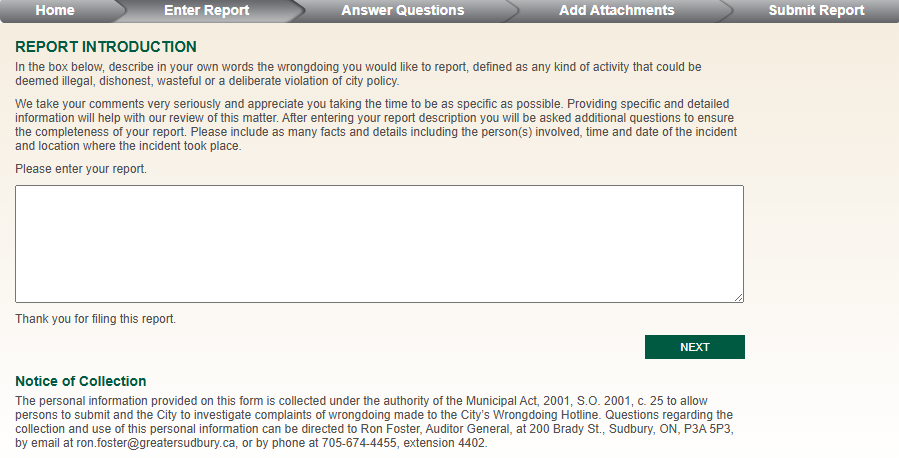
The Wrongdoing Hotline is a confidential and anonymous service currently overseen by the CAO’s office. Everyone may use this service, including citizens, municipal employees and municipal contractors, seven days a week and 24 hours a day to report suspicion or proof of wrongdoing, defined as any kind of activity that could be deemed illegal, dishonest, wasteful or a deliberate violation of city policy. Submit a secure form online at www.sudburycomplaints.ca.
Where should I file my complaint?
Residents who require assistance or have general questions or complaints about City services such as waste collection, snow plowing and By-law Services or other programs should not contact the hotline to resolve their complaint. Concerns about the City’s services and programs should be reported to the City’s 311 Call Centre for resolution.
The hotline should only be used to report allegations of wrongdoing which is defined as any kind of activity that could be deemed illegal, dishonest or wasteful or a deliberate violation of city policy. Several definitions of wrongdoing activities are provided below.
What is Theft?
Theft is taking another person’s property without permission or consent with the intent to deprive the rightful owner of the object. In this case, “person” includes the City of Greater Sudbury. Examples of theft include, but are not limited to:
- Misappropriation, embezzlement or theft of city funds, supplies or any other asset.
- Inappropriate use of corporate time or corporate facilities.
What is Fraud?
Fraud is a wrongful or criminal deception that results, or has potential to result, in financial or personal gain. Examples of fraud include, but are not limited to:
- Forgery.
- Irregularities in the handling or reporting of monetary transactions.
- Unauthorized use or misuse of city property, equipment, materials or records.
- Misuse of city-owned hardware and software.
- Claims for reimbursement of expenses that were not made for the exclusive benefit of the city.
- Irregular claims for benefits.
What is Waste?
Waste refers to the inefficient use of municipal resources and refers to any operation, process or activity in which municipal resources may be used without due regard for value for money and/or where opportunities may exist to save money.
What is Abuse?
Abuse involves behavior that is deficient or improper when compared with behavior that a prudent person would consider reasonable and necessary, given the facts and circumstances in a business practice. Abuse also includes the misuse of authority or position for personal financial interests or those of a family member or business associate. Examples of abuse include, but are not limited to:
- Conflict of interest.
- Seeking or accepting anything of material value from vendors, consultants or contractors doing business with the city.
- Bribery.
- Nepotism.
- Unauthorized access, use or misuse of privileged or personal information.
- Improper employee conduct.
Who Can Be Investigated?
Complaints may be filed regarding City of Greater Sudbury:
- employees,
- management,
- contractors and
-
political office staff.
The wrongdoing hotline should not be used to file complaints about:
- the Mayor or Members of Council.
These complaints should be filed separately to the City's Integrity Commissioner.
Agencies, boards and wholly-owned corporations of the City of Greater Sudbury are not included in the city’s complaint resolution process, including:
- Greater Sudbury Public Library Board,
- Greater Sudbury Police Services Board,
- Downtown Sudbury Business Improvement Area Board,
- Flour Mill Business Improvement Area Board,
- Sudbury & District Health Unit,
- Greater Sudbury Utilities Inc.,
- Greater Sudbury Development Corporation,
- Greater Sudbury Housing Corporation and
- Sudbury Airport Community Development Corporation
Please contact these organizations directly with your complaint.
What are Workplace Issues?
Workplace issues include concerns about staff members that have been raised but not addressed by a staff member's immediate supervisor or manager. Complaints about staff members that have not been resolved to the satisfaction of the complainant should be forwarded to senior management or to Human Resources personnel for resolution or included in a formal grievance.
The hotline should only be used by City staff to address issues that remain unresolved after following the escalation process outlined above.
How is my Identity Protected When Submitting a Complaint?
While complaints may be submitted anonymously to the Hotline, in some circumstances investigators may be unable to follow up on a complaint without knowing the identity of the complainant. In these circumstances, the complainant will be asked whether they consent to revealing their name to the investigator.
Who Conducts the Investigations?
Allegations of illegal, dishonest, wasteful or deliberate violations of City policies will be forwarded to the following individuals for investigation. All are bound by confidentiality provisions of their employment.
- The Director of Human Resources will coordinate investigations regarding City staff.
- The Chief Administrative Officer will coordinate investigations regarding the Director of Human Resources .
- The Chief Administrative Officer will coordinate investigations regarding the Mayor and political office staff in consultation with the City Clerk.
Anyone who believes their complaint remains unresolved following conclusion of the local complaint resolution process has the right to contact the Office of the Ontario Ombudsman for further investigation. Please note the Ontario Ombudsman will not accept complaints for investigation until an investigation has concluded at the municipal level. The website of the Ontario Ombudsman states that: “The Ombudsman recommends solutions to fix problems of maladministration. They cannot overturn decisions made by municipalities, school boards or universities.”
How are Investigations Conducted?
Complaints should be about a specific incident. Please provide specific and detailed information that will help with the investigation, including the person(s) involved, time and date of the incident and location of where the incident took place.
Complaints are reviewed to determine whether the submission is reasonable and valid for further investigation. When required, information may be forwarded to law enforcement or other outside legislated authorities.
Each complaint will be reviewed and directed to the appropriate service area for follow up. If your submission does not relate to a specific service area, updates will be provided to you by email or phone. You may also be contacted with additional questions to help us better understand and address your concern. Complainants have the option of submitting their name and personal contact information if they wish to be contacted by the staff member who is conducting the investigation. In some cases, it may not be possible to further the investigation without asking the complainant whether they consent to provide their name to the investigator.
Complaints under investigation will receive an appropriate, objective and impartial investigation, regardless of the alleged wrongdoer’s position, title or length of service with the city. Complaints may be dismissed summarily, however, if they are found to be frivolous, vexatious or repetitive
When will Complaints be Resolved?
The City has established the following targets for resolving complaints:
Deliverable |
Targets for Complaint
|
|
Initial assignment of complaint |
5 business days |
|
Preliminary review of complaint |
30 calendar days |
|
Simple complaint |
60 calendar days |
|
Substantial complaint |
90 calendar days |
|
Complex complaint |
120 calendar days |
If your complaint is not being resolved in accordance with the above time lines, you should contact the Office of the CAO for an explanation. If you remain unsatisfied, you can escalate your concern to the Chair of the Audit Committee.
How are Investigations Monitored and Reported to Council?
The Office of the CAO monitors the wrongdoing hotline and assign complaints for investigation. Council is made aware of outcomes through a report that is presented by the Office of the CAO.