
Water Distribution Networks
Once treated, water is ready for distribution to users. The water network, spanning roughly 1,796 km of pipes and tunnels in Greater Sudbury, delivers water from treatment plants to homes and buildings. The system primarily uses Polyvinyl Chloride (PVC) pipes, but also includes Ductile Iron, Cast Iron, Steel, High Density Polyethylene (HDPE), and Concrete.
Water from the Wahnapitae plant is pumped to Markstay, Coniston, or New Sudbury, while the David Street plant supplies water to the south, west, and downtown areas. Both plants also send water to the Ellis Reservoir, where it is stored before being redistributed.
The water distribution system consists of a network of pipes that transport potable water from a treatment facility to customers who are serviced within the system. Sudbury’s distribution system is made up of three primary types of service lines.
- City water mains that deliver potable water from the City’s treatment plant to neighbourhoods.
- Public service lines that connect City watermains to private properties.
- Private service lines that receive water from the public service line and distribute it to all buildings on a property.
NOTE: The dividing point between the public and private service is located at the property line.
The drawing below illustrates the public and private components of the water distribution system.
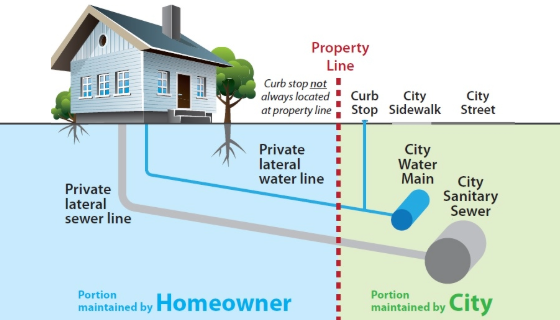
The City owns the public water distribution system which carries potable water from the City’s water treatment plant to homes served by the system, and is responsible for:
- Regular inspection, maintenance, repair, rehabilitation, and replacement of watermains within the City’s water distribution system.
- The replacement of any public lead service lines to a material approved by the City.
Property owners are responsible for the maintenance of any private service lines located within the property line, including:
- The installation, repair, maintenance, and replacement of private water service lines that connect the City owned service lines to the buildings on their property.
- The installation, repair, maintenance, and replacement of the plumbing within the home.
- The hiring of an approved licensed contractor when necessary to complete any work and ensuring the procurement of all associated permits
Water flow through watermains
The water distribution system is pressure driven from the City’s two water treatment plants and booster stations. Drinking water is distributed through the system by using pumps at booster stations that create pressure differences which dictate the flow of water within the system.
Unlike air, liquid water is incompressible, therefore any force exerted on it will cause it to experience one of three states of motion.
- Laminar flow : a relatively smooth linear flow
- Turbulent flow : convective flow (changes in the orientation, density, and flow rate of water)
- Transitional flow: section where the flow behavior gradually changes from laminar to turbulent
The large pumps at water treatment plants and booster stations can send pressure waves through the system as they turn on and off, adding unnecessary stress to water distribution infrastructure. Maintaining a laminar flow within the water distribution system helps to minimize pressure and stress on water/wastewater infrastructure.
Finding and repairing leaks in the Water Distribution System
Leaks are a common issue in both homes and the City’s water distribution system. As the community grows and water demand increases, the City must ensure its system can accommodate this growth. Expanding the system would involve substantial upfront and ongoing costs.
Water and wastewater operations are the most energy-intensive municipal services. Reducing leaks helps conserve energy, delays costly system expansions, and supports the City’s goal of achieving net-zero emissions by 2050, as outlined in the Community Energy and Emissions Plan (CEEP).
Leaks in water systems are a global challenge, driven by various factors such as:
- Aging infrastructure
- Defective materials
- Corrosion
- Pressure surges
- Ground and soil movement
- Ground vibrations caused by construction, or earthquakes.
What the City is doing
Treating the water distribution system with care helps minimize leaks.
The City has conducted many studies and projects that, combined, have led to the discovery of substantial leaks within our water distribution system. Studies of our water distribution system have also led to upgrades and design recommendations that help minimize pressure waves within the system.
There are also a variety of tools and techniques used by the City to find leaks in our water distribution system.
- City operators use sound devices on metallic pipes to hear leaks (similar to when you turn on the water in a home and hear the old pipes creak). New technology is also being placed in hydrant caps connected to metallic watermains to scan for any sounds of leaks.
- Advanced Meter Infrastructure (AMI) technology also allows the City to compare the volume of water distributed from all water treatment facilities to the amount of water consumed by customers, giving City staff a more accurate understanding of the total water losses in the system in real-time.
What you can do
Try to conserve more water by incorporate the 4R principles for water efficiency into your daily routines:
- Reduce overall water usage
- Reuse non-potable water around your home as much as possible
- Repair leaks in your home
- Replace faulty appliances and fixtures
Learn more about water conservation and how to become a leak detective!