Sudbury Rock Tunnel
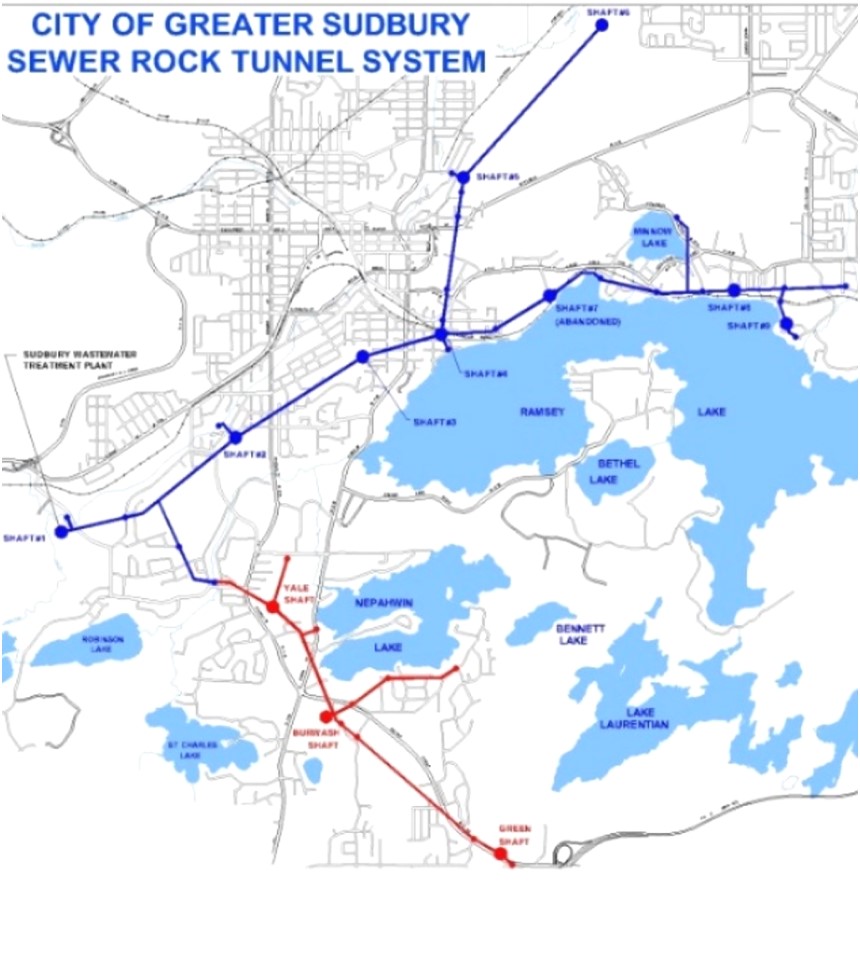
Sudbury’s Rock Tunnel is a large feature of the City’s sanitary sewer system that is quite unique.
The tunnels are located, on average, at a depth of more than 25 meters below the ground, and measure 1.5 meters wide by 2.1 meters high. The sheer size of the tunnel helps minimize water surcharge events and when necessary, it allows the entire treatment plant to shut down for maintenance.
This unique sewage infrastructure has proven to be very cost-effective and durable, requiring little to no maintenance over more than a half-century. The main tunnels were initially constructed in 1961 by utilizing the same traditional drilling and blasting methods used in mining. During construction, broken rock was removed and hauled to the surface through mine shafts using a train system. The roof of the tunnels is arched, while the base is designed to be V shaped as to allow sewage to flow more readily within the system. Over the years the Rock Tunnel has been expanded upon with the construction of:
- the Lockerby tunnel in 1967 which was designed to connect the Lockerby area of the City to the main tunnel;
- the Minnow Lake Tunnel in 1973, which stretches nearly 5 km and has eliminated the need for 9 lift stations, and;
- the South End Tunnel in 2005 which is roughly 6.5km in length, has eliminated 6 lift station and has won a variety of different awards including the “2010 Ontario Public Works Association Public Works Project of the Year” Award.
The expansions have provided these regions of the city with adequate capacity for growth and development while mitigating the environmental concerns that are associated with limited sanitary sewer capacity.
Today, the Rock tunnel measures roughly 21 km in length.