PROJECT OVERVIEW
Like many cities throughout North America, Sudbury receives a number of requests from residents for traffic calming measures on its streets. Traffic calming includes physical or regulatory measures that reduce the negative effects of motor vehicle use, alter driver behaviour and improve conditions for non-motorized street users. As a result, the City has initiated a study to develop a comprehensive traffic calming policy, including a process for identifying and prioritizing traffic concerns, and the subsequent implementation of appropriate corrective measures. The final product of this study will be a detailed traffic calming policy that is developed and presented to Council for consideration in summer 2008.
A key component of this study is the development of a pilot traffic calming project for the Southview Drive / Bouchard Street corridor between Regent Street and Janmar Court. Two public meetings will be held to 1) introduce the project, discuss issues and potential mitigating measures and 2) present alternative solutions leading towards a preferred alternative.
The first Public Open House will be held on:
Thursday, May 8, 2008
7:00 - 9:00 PM (presentation at 7:30 PM)
Corpus Christi School
811 Robinson Drive
Public consultation is important to us and vital to this study. We want to ensure that anyone with an interest in this study has the opportunity to get involved and provide input before any decisions are made. We invite you to leave feedback by taking our short traffic calming survey. www.surveymonkey.com/s.aspx?sm=WIi5nelzSX3dmEhuc_2bu7Qw_3d_3d.
DESCRIPTION AND OVERVIEW OF TRAFFIC CALMING
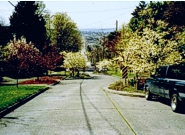
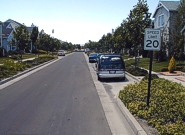
Traffic calming represents a component of traffic management techniques to reduce the impacts of traffic on neighbourhood communities and other public facilities such as parks, school areas, and community centres. Traffic calming has been used in North America to:
-
Improve neighbourhood liveability;
-
Increase road user safety;
-
Implement crime prevention programs through access restriction methods such as road closures and one-way streets; and
-
Promote urban redevelopment.
Communities throughout North America have experienced significant growth in traffic due to automobile dependence and urban sprawl. These trends in automobile travel have placed considerable strains on the road network and the ability to safely (e.g., perceived or real collision potential) accommodate all road users within the public right-of-way. In many cases, the lack of arterial road capacity has resulted in motorists choosing to use collector and residential roadways to circumvent a congested turning movement, intersection or corridor.
In summary, there are a number of negative traffic impacts in some of the communities that result from inappropriate use of neighbourhood streets by drivers, as listed below. In general, these typically occur in older established neighbourhoods next to busy traffic areas. However, traffic issues may also occur in newer subdivisions depending on the road network and adjacent activities:
-
Arterial road congestion results in motorists looking for parallel or alternative routes to reach their destinations;
-
These parallel/alternative roads accommodate greater traffic volumes and begin to function as they were never intended. For example a local residential or collector roadway becomes a mid-block arterial road;
-
Motorists operate vehicles at speeds which are not appropriate for the residential roadway and/or the roadside environment;
-
The safety of all road users is decreased due to volume, speed and other compliance issues; and/or
-
Enforcement resources are called upon to provide frequent enforcement of numerous problem areas and cannot sustain the level of enforcement to effectively address these traffic related issues.
One response to these problems is the self-enforcing option of traffic calming devices. Provided below is a summary of the general benefits and disbenefits of traffic calming, followed by an overview of available devices.
BENEFITS AND DISBENEFITS OF TRAFFIC CALMING
In the development of the Canadian Guide to Neighbourhood Traffic Calming(Transportation Association of Canada / Canadian Institute of Transportation Engineers, December 1998), www.ite.org/traffic/tcstate.htm#cgntc, a detailed review of the potential benefits and disbenefits of traffic calming measures was undertaken to provide some guidance in terms of device application to specific types of roadways and their impacts. The following table lists the major considerations in selecting applicable traffic calming devices.
Potential General Benefits/Disbenefits of Traffic Calming Measures
|
Factor |
Description |
|
Speed Reduction |
Potential reduction in vehicle speeds along the traffic calmed street |
|
Volume Reduction |
Potential reduction in volume of through traffic on a street |
|
Conflict Reduction |
Potential reduction in road user conflicts |
|
Local Access |
Extent to which a measure restricts local traffic |
|
Emergency Response |
Potential delay as a result of slowing down to traverse a traffic calming measure and restriction of access |
|
Enforcement |
The need for police enforcement for a measure to be effective |
|
Other Travel Modes |
Access restrictions, safety implications or other disbenefits to pedestrians, bicycles, transit and service and delivery vehicles |
|
Maintenance |
Increase maintenance time for snow clearing, street sweeping, garbage collection, maintenance of landscaping, etc. |
|
Note: This table provides general benefits/disbenefits resulting from traffic calming installations. The sections below summarize benefits/disbenefits of specific traffic calming devices. | |
TRAFFIC CALMING DEVICES
The Canadian Guide categorizes traffic calming devices into four broad categories. Provided below is an overall comparison of the devices in each category, their intended function/benefits and potential disbenefits. Detailed information on the benefits and disbenefits can be found in the Canadian Guide.
Horizontal Deflection
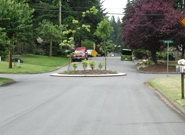
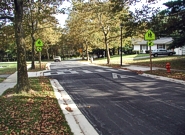
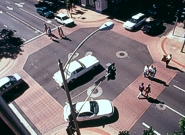
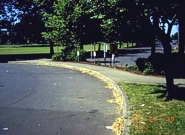
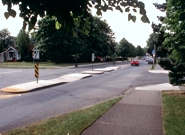
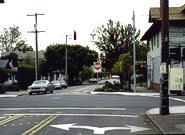
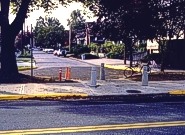
Horizontal deflection devices include chicanes, curb extensions, corner radius reductions, on-street parking, raised median islands, and traffic circles.
![]() |
|
![]() |
|
![]() |
|
Advantages:
-
Effective in reducing average and/or higher operating speeds
-
Devices such as curb extensions reduce road user conflict potential
-
Devices typically do not impact emergency vehicle response times on lower order roads
Disadvantages:
-
Maintenance activities such as street cleaning and snow removal are complicated in the vicinity of device
-
A number of the devices may impact transit and cyclist operations due to constrained travel portions of the roadway
-
Typically do not impact through traffic volumes
Vertical Deflection
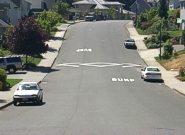
Vertical deflections include raised crosswalks, raised intersections, speed humps (as opposed to speed bumps which are typically found on private roads, laneways and in parking lots), and textured sidewalks.
![]() |
|
![]() |
|
![]() |
|
Advantages:
-
Effective in reducing operating speeds
-
Do not impact local access
Disadvantages:
-
Devices have the potential to impact emergency vehicle response times, as they are required to slow down for the devices to ensure they do not damage their vehicles or upset their cargo or passengers
-
Devices may increase maintenance requirements
-
Typically do not impact through traffic volumes significantly
Obstruction
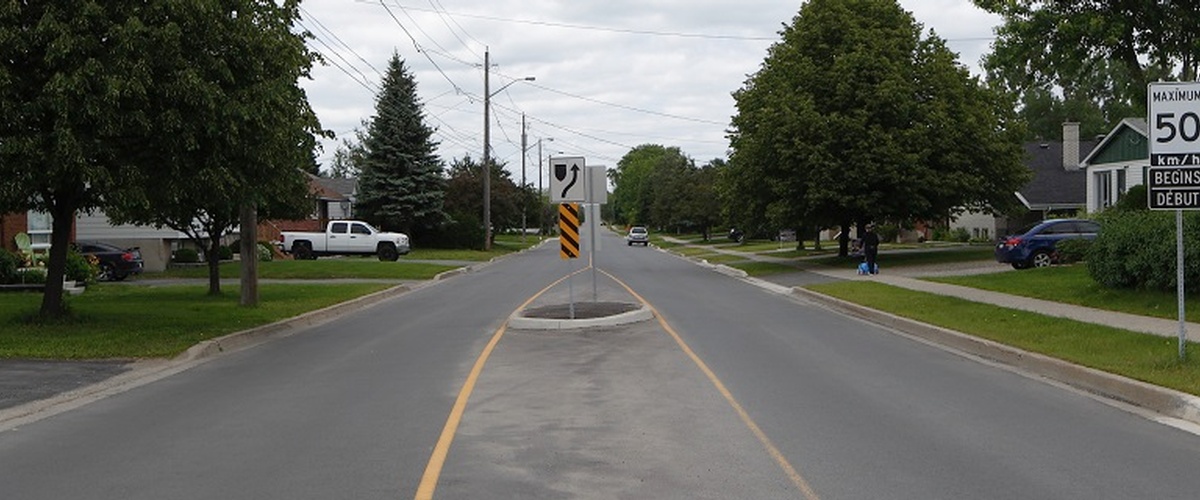
Included in this category are partial and full roadway closures, intersection diverters, raised medians and right-in-right-out channelized islands. The main purpose of these devices is to reduce infiltrating traffic on neighbourhood streets.
![]() |
|
![]() |
|
![]() |
|
![]() |
|
Advantages:
-
Reduces road user conflicts and volumes
-
Requires little or no enforcement
Disadvantages:
-
Penalizes local traffic access
-
Reduces access to transit, emergency services, delivery service, etc.
-
Complicates road maintenance efforts in the vicinity of devices
-
Potential to divert both local and through traffic to parallel or alternative routes
Signing
These devices are sometimes used as traffic calming devices and include both regulatory and warning signs, including stop and yield controls, maximum speed, turn prohibitions, 'traffic calmed neighbourhood” signs.
Advantages:
-
Has the potential to reduce vehicle speeds and volumes
-
Reduces road user conflicts
-
Relatively inexpensive
Disadvantages:
-
Frequent enforcement is required to be effective
-
"Traffic calmed neighbourhood" and 'No through traffic” signs are not regulatory signs that can be enforced
-
May reduce local access in the case of one-way streets and turn restrictions.
Get in Touch
If you would like more information, to provide us with additional comments, or to be put on our study mailing list, please contact either of the individuals below.
|
Dave Kivi |
Tom Prestia, P.E. Project Manager IBI Group 230 Richmond Street West, 5th Floor Toronto, ON M5V 1V6 Tel: (416) 596-1930 x1336 Fax: (416) 596-0644 tprestia@ibigroup.com |